
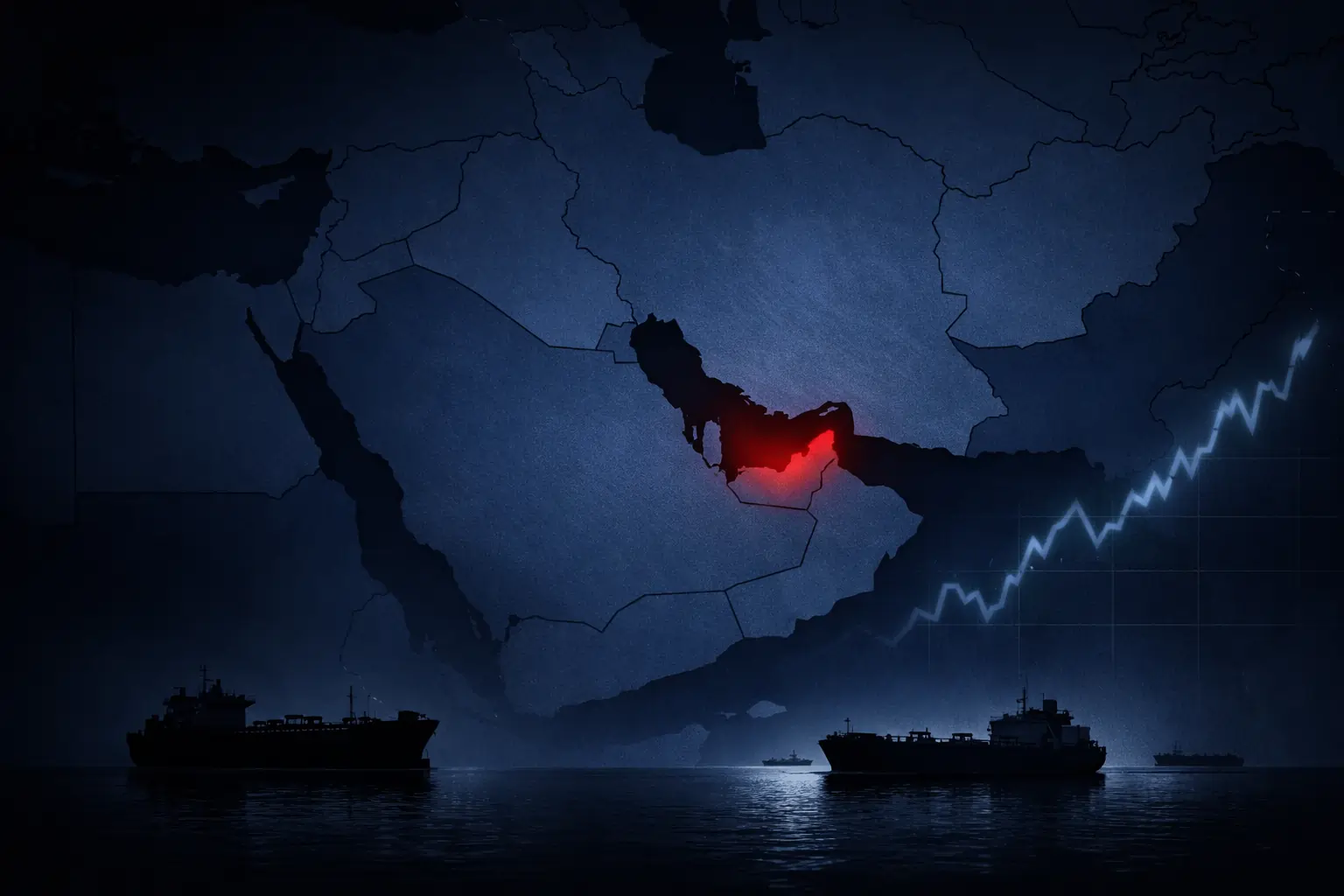
As of March 14, 2026, the Strait of Hormuz is no longer a geopolitical headline — it is the central macro variable for global energy, inflation, and risk assets.
Since the Middle East conflict began on February 28, export volumes of crude and refined products through Hormuz have fallen to less than 10% of pre-conflict levels, shipping traffic through the strait has dropped by about 90%, Brent has climbed nearly 40% since hostilities began, European TTF gas is up almost 60%, and the IEA has already approved a 400 million barrel emergency stock release — the largest in its history.
Why does that matter so much?
Because Hormuz is not just another shipping lane. In 2025, roughly 20 million barrels per day of crude and oil products moved through the strait, equal to around 25% of global seaborne oil trade, while about 20% of global LNG trade also transited the route. The problem is that alternative routes are nowhere near large enough to absorb a serious shutdown: EIA estimates only about 2.6 million barrels per day of Saudi and UAE pipeline capacity could bypass the strait, and the IEA says Iran’s Jask terminal is not currently a viable crude export option.
That means this is not a paper premium. It is a physical supply shock.
Too many market participants still talk about Hormuz as if it were just a fear trade layered on top of oil. That is wrong. When export volumes collapse, insurers pull back, shipowners hesitate, and freight rates explode, the market stops being about sentiment and starts being about molecules that cannot move. That is exactly why the IEA is treating this as the largest supply disruption in the history of the global oil market.
The first macro consequence is obvious: higher oil.
But the second-order effect is even more important. A sustained Hormuz disruption would not simply raise crude prices; it would push up diesel, jet fuel, petrochemical feedstocks, and freight costs at the same time. UNCTAD is already warning that the disruption is hitting energy, fertilizers, and broader supply chains, which is exactly how a commodity shock turns into a wider inflation shock.
The third consequence is that Europe and Asia are more exposed than the United States.
The IEA says Dutch TTF gas prices were up almost 60% as of March 12, while the EIA expects U.S. natural gas prices to be relatively unaffected by the Hormuz disruption. That makes this crisis structurally more stagflationary for Europe and Asia than for the U.S., and it strengthens the case for owning U.S.-centric producers over energy-importing industrials. That is the kind of nuance most shallow crisis takes miss completely.
The fourth consequence is monetary.
Oil supply shocks do not just raise CPI for a month and disappear; IMF work shows they reverberate through labor markets and inflation dynamics in immediate and uneven ways, with importers typically taking the bigger hit. In plain English: if Hormuz stays impaired, central banks get less room to ease, growth expectations get squeezed, and the macro backdrop shifts from “soft landing” to “energy-led stagflation scare.”
So what is the real trade?
Not every oil stock wins. Not every shipping stock wins. And not every defense stock is equally exposed. The cleanest setup is in companies that either monetize higher freight rates directly, sell non-Hormuz barrels into a tighter market, or benefit from rising missile-defense and replenishment demand. The bad setup is in companies whose assets are physically trapped inside the problem or whose margins get crushed by higher input costs. That is the distinction that matters.
Stocks that could benefit from the Hormuz crisis
1) Frontline (FRO)
Why it fits: Frontline is one of the purest listed ways to play a crude shipping shock. The company says it operates a large fleet of VLCCs, Suezmax tankers, and LR2/Aframax vessels, and its latest strategic update points to a fleet of 81 vessels post-transaction, including 42 VLCCs. In a world of rerouting, war-risk insurance, and constrained tanker availability, spot-exposed crude tanker owners get paid first. Barron’s has already highlighted Frontline as one of the obvious winners from a Hormuz closure. FRO last traded at $30.18.
What breaks the thesis: A fast ceasefire or aggressive naval normalization could crush freight rates just as quickly as they spiked. Tanker trades are brutal if you are late.
2) DHT Holdings (DHT)
Why it fits: DHT is even cleaner than Frontline if you want direct VLCC beta. The company describes itself as an independent crude tanker owner whose fleet trades internationally in the VLCC segment. When the market pays up for large crude carriers, DHT has very little operational clutter hiding the exposure. DHT last traded at $16.85.
What breaks the thesis: Same problem as Frontline: if the panic eases, rates can normalize hard. Great crisis vehicle, poor “forget about it for two years” vehicle.
3) Exxon Mobil (XOM)
Why it fits: Exxon is the conservative way to express the view. In its latest results, Exxon said fourth-quarter production reached 5.0 million oil-equivalent barrels per day, including 1.8 million boe/d in the Permian, while Guyana approached 875,000 gross barrels per day. That matters because higher crude prices can feed through to a huge portfolio of advantaged barrels that are not trapped inside Hormuz. XOM last traded at $156.12.
What breaks the thesis: Integrated majors are less explosive than tanker names or shale pure plays. Refining can also offset some upstream upside if crack spreads or demand weaken.
4) Occidental Petroleum (OXY)
Why it fits: OXY is a higher-torque oil name than Exxon. Occidental said fourth-quarter 2025 production averaged 1,481 thousand barrels of oil equivalent per day, led by the Permian and Rockies. If the world moves from “higher risk premium” to “real barrel scarcity,” levered U.S. upstream names with large domestic resource bases become much more interesting. OXY last traded at $57.88.
What breaks the thesis: More balance-sheet sensitivity and more share-price volatility. Better upside torque, lower forgiveness if crude rolls over.
5) Permian Resources (PR)
Why it fits: This is the smaller-cap torque play. Permian Resources’ latest update says its 2026 plan is focused on maximizing free cash flow per share and improving capital efficiency, while its investor materials point to roughly 400 MBoe/d of total production. If you want a pure U.S. shale beneficiary rather than a global integrated major, PR is the sharper instrument. PR last traded at $19.35.
What breaks the thesis: Higher beta cuts both ways. Great if oil keeps pushing higher; painful if the market suddenly prices a diplomatic off-ramp.
6) RTX (RTX)
Why it fits: Hormuz is not only an oil trade. It is also a regional air-defense and missile-defense trade. RTX reported a $268 billion backlog at year-end 2025, including $107 billion in defense, and Raytheon’s Patriot system is already used by 19 nations. In a world of sustained Gulf insecurity, missile interception, air defense, replenishment orders, and allied procurement remain obvious follow-on themes. RTX last traded at $204.52.
What breaks the thesis: Defense procurement often moves slower than markets expect. Good hedge, but not always the fastest trade.
7) Lockheed Martin (LMT) — bonus hedge
Why it fits: Lockheed reported a record $194 billion backlog for 2025 and described demand as “unprecedented.” If the Middle East shock broadens into a longer rearmament and replenishment cycle, Lockheed remains one of the highest-quality geopolitical hedges in the market. LMT last traded at $646.00.
The cleaner way to think about this setup
Best direct beneficiaries: Frontline, DHT.
These names are effectively toll roads on fear, rerouting, and tanker scarcity.
Best oil-price beneficiaries outside the Gulf: Exxon, Occidental, Permian Resources.
These names monetize higher global crude without needing Hormuz to be open.
Best geopolitical hedge: RTX, Lockheed Martin.
If the crisis evolves from an energy shock into a broader regional rearmament cycle, these names stay relevant even if crude cools.
Who probably gets hurt
Airlines, European chemicals, margin-sensitive transport businesses, and energy-import-heavy manufacturers look much worse in this setup. The reason is straightforward: UNCTAD says Hormuz disruption is hitting energy, fertilizers, and supply chains, while the IEA and EIA are showing a much harsher gas-price shock for Europe and Asia than for the U.S.
Closing punch
The Strait of Hormuz crisis is not a “headline war trade.” It is a live stress test for the global energy system. If the disruption proves short, tanker stocks likely remain the best pure tactical winners. If it lasts, U.S. upstream names and missile-defense suppliers become more compelling. And if the market keeps pretending this is just another temporary geopolitical scare, it is still underestimating how fast a chokepoint shock can turn into an inflation shock.




0 Comments